§3
THE EMPIRICAL FOUNDATIONS
Five findings the discipline stands on
Signaling, not merely power
Mitochondria are signaling organelles, not merely energy plants.
Beyond producing ATP, they regulate calcium, govern apoptosis, participate in innate immune signaling, generate reactive oxygen species (ROS) that function as deliberate messengers, and release peptides and metabolites that communicate systemically. Picard and McEwen extend the picture to the integration of behavioral and psychosocial inputs. The organelle became mappable through the work of pioneers like Douglas Wallace, who founded human mitochondrial genetics, and Vamsi Mootha, whose MitoCarta inventory rendered its proteome a systematically studiable system.[Monzel 2023][Picard 2022][Picard 2018][Wallace 2005][Pagliarini 2008]
CULINARY CONSEQUENCE
If the organelle listens and responds, then the food that reaches it is a message, not just fuel. A cuisine can therefore be composed as a set of intended signals rather than merely a set of nutrients.
Food-based interventions shift metabolic markers and biological age
Food-based interventions produce measurable biological change, not merely subjective well-being.
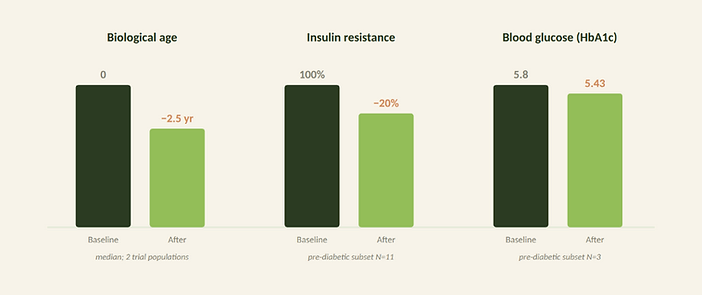
The strongest evidence comes from randomized controlled trials of the fasting-mimicking diet (FMD) — a periodic, low-calorie, low-protein protocol designed to trigger fasting-like states while a person still eats. In an analysis of trial data, cycles of the FMD were associated with an estimated reduction of about 2.5 years in a measure of biological age, alongside improvements in markers of insulin resistance and hepatic fat, with the biological-age effect reported as independent of weight loss. The mechanism Valter Longo's laboratory proposes is a coordinated down-shift in the body's nutrient-sensing pathways — insulin, IGF-1, and mTOR — the conserved signals that set lifespan from yeast to humans. Levine's analysis sharpened this into an explicitly age-dependent rule: in people aged 65 and younger, lower protein intake tracked sharply reduced IGF-1 and mortality, yet the association reversed after 65, where adequate protein became protective. The same lever points in opposite directions at different ages — a caution the cuisine carries rather than hides.[Brandhorst 2024][van den Burg 2024][Sutton 2018][Fontana 2010][Levine 2014]
AN HONEST CAVEAT
Honesty requires stating the limits alongside the headline. The most robust and generalizable result is the biological-age change. The improvement in insulin resistance (HOMA-IR) was measured in a pre-diabetic subset of roughly eleven participants, and the change in HbA1c in a pre-diabetic subset of only three. A small subgroup can be suggestive; it cannot be load-bearing. Any figure reporting these outcomes must display the subgroup sample size as prominently as the effect.

CULINARY CONSEQUENCE
Deliberate structuring of what and when we eat can move the body's biology in a measurable, favorable direction — partly through pathways independent of simple caloric loss. This licenses a cuisine to treat metabolic signaling and timing as design variables, while forbidding it from promising any individual a specific clinical result.
Compounds engage defined pathways through hormetic and xenohormetic mechanisms
Specific, cookable food compounds engage specific, named molecular machinery.
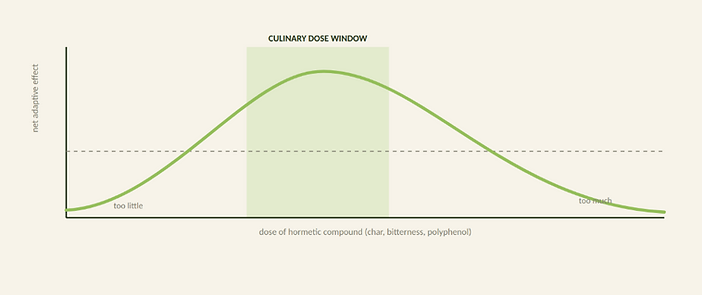
Two mechanisms matter most. The first is the induction of mitochondrial biogenesis — the making of new mitochondria — coordinated by the transcriptional coactivator PGC-1α (discovered by Bruce Spiegelman's laboratory) and its upstream regulators, the energy sensor AMPK and the NAD⁺-dependent deacetylase SIRT1. Navdeep Chandel's work established that the reactive oxygen species mitochondria emit are deliberate signals, not merely damage — the mechanistic basis of the hormetic response. The second is hormesis: a mild, transient stressor provokes an adaptive response larger than the stress itself, for example activating the Nrf2 pathway that governs endogenous antioxidant and detoxification responses. A deeper evolutionary account is xenohormesis — plant defensive compounds acting, at the low doses humans consume, as mild stressors that activate our own adaptive signaling. The signature of hormesis is a biphasic dose–response curve: too little yields no signal; too much becomes damage.[Chodari 2021][Perrone 2025][Vannuchi 2025][Lettieri-Barbato 2019][Divyajanani 2023][Puigserver 1998][Sena 2012]

CULINARY CONSEQUENCE
Ingredient selection and technique are levers on named biological pathways — but only within a calibrated dose window. The chef's art becomes, in part, the art of dosing a signal: enough to speak to the cell, never enough to shout.
Quality control: build and clear
Cellular-energy health is set by the quality of the mitochondrial pool a cell maintains — not merely by how many it builds.
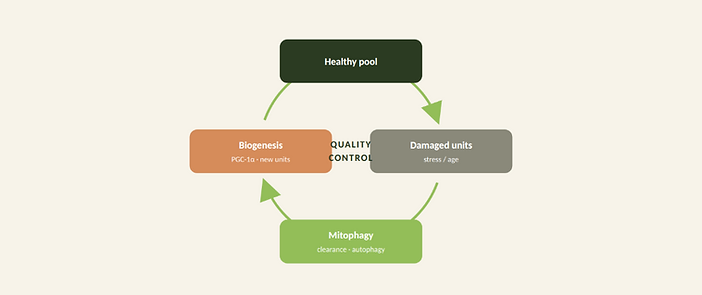
This depends as much on clearing damaged mitochondria as on making new ones. This coupled process is mitochondrial quality control, with three motions: biogenesis (building, via PGC-1α), mitophagy (the selective clearance of damaged mitochondria), and dynamics (the fusion and fission that mix contents and isolate damage). Urolithin A, a gut-derived metabolite of dietary ellagitannins, activates mitophagy and has improved mitochondrial biomarkers in human trials; the dietary polyamine spermidine induces autophagy and its mitochondrial subset. The fasting-mimicking diet of Foundation II works partly by inducing autophagy — the same clearance program spermidine engages.[Andreux 2019][Ryu 2016][Eisenberg 2016][López-Otín 2023]

CULINARY CONSEQUENCE
A cuisine composes for two motions, not one: the biogenesis-leaning signals of char and bitterness, and the clearance-supporting compounds and intervals that keep the pool clean. The unit of design is not the single stimulus but the cycle of stress and recovery.
Substrate is signal
A mitochondrion responds not only to the compounds around it, but to which fuel it is asked to burn — and that metabolic state is itself information.
The clearest example is the ketone body β-hydroxybutyrate (BHB). During fasting, prolonged exercise, or carbohydrate restriction, the liver synthesizes BHB from fatty acids and exports it as fuel. But BHB is not only fuel. It is an endogenous inhibitor of class I histone deacetylases (HDACs) — a metabolite that reaches into the nucleus and alters which genes are read, including genes for oxidative-stress resistance. It is also a ligand for cell-surface receptors (HCAR2/GPR109A and FFAR3), and it drives lysine β-hydroxybutyrylation, a post-translational modification now shown to regulate the enzymes of ketone metabolism itself. A fuel molecule, in other words, doubles as an epigenetic and hormonal signal. A corollary follows: the capacity to switch cleanly between burning glucose and burning fat — metabolic flexibility — is itself a readout of mitochondrial health, since well-conditioned mitochondria move between fuels with ease while inflexible ones stall. San Millán and Brooks made the trait measurable through lactate and fuel-oxidation responses, and the physician-communicator Peter Attia has since placed metabolic flexibility at the centre of popular longevity discourse — a synthesis we cite as communication, distinct from the primary research it draws on.[Shimazu 2013][Newman 2017][Fang 2025][Wang 2021][San-Millán 2018][Attia 2023]
CULINARY CONSEQUENCE
If the fuel is a signal, then a cuisine composes not only compounds but substrate context — the metabolic key the meal is played in. It can build lighter, lower-glycemic sequences, and use honest fasting-like intervals, so that a meal invites the body's own fuel-switching. What it composes is a context, never an outcome.
·No dish, ingredient, technique, fuel state, or dietary pattern described in this work treats, cures, or prevents any disease. The peer-reviewed science is cited to the researchers who produced it; the culinary theory, the design principles, and the honest line are the founder's.