Preface
This book founds a culinary discipline; it does not complete one. Mitochondrial Cuisine begins from a real and well-documented shift in the science of the organelle that governs cellular energy — from a passive powerhouse to a listening, signalling processor — and asks a narrow, honest question: what does a cuisine look like if it takes that organelle as its organizing principle, and what could it truthfully say?
The answer offered here is a thesis, five empirical foundations, six commitments, a set of executable design principles, a compound-to-pathway grammar, and a falsifiable research agenda — held together by a refusal to claim more than the evidence allows. The discipline's single non-negotiable — that no dish treats, cures, or prevents disease, that established science is cited to its authors, and that original theory is labelled as mine — is not a disclaimer bolted to the end of the book. It is the reason the book is allowed to exist, and it is stated plainly wherever the text speaks of science and enforced hardest where the temptation to cross it is greatest.
What remains is the work: dishes cooked, hypotheses tested, principles revised in public as the evidence lands. This founding edition is offered in that spirit — a theory to be refined, a practice to be built, and an invitation to the laboratory and the kitchen to meet, at last, with rigor and without hype.
— Luke Wu & Reanne Wu · Christiansted, St. Croix · 2026
Abstract
Over the past two decades, the mitochondrion has been reconceived from a passive adenosine-triphosphate (ATP) generator into a dynamic signaling organelle that senses nutritional, physical, and psychosocial inputs and transduces them into cellular and organismal adaptation. This reframing has an underexploited implication for the culinary arts: if the organelle that governs cellular energy is a listening, integrating processor, then food is not merely fuel but information — a structured set of molecular signals the body's energy machinery reads. Here I formalize Mitochondrial Cuisine, a culinary theory and design framework organized around this premise. The framework rests on five empirical foundations drawn from peer-reviewed research; from these I derive a central thesis, a set of design principles, a compound-to-pathway grammar, and a falsifiable research agenda. Crucially, the framework is bounded by a single non-negotiable constraint — an evidence-graded firewall and an explicit honest line: no dish, ingredient, technique, or dietary pattern is claimed to treat, cure, or prevent any disease.[Picard 2018][Monzel 2023][Picard 2022][Shimazu 2013][Newman 2017]
Introduction
There is a persistent gap between the science of nutrition and metabolism and the daily craft of cooking. The former communicates in the language of mechanism and statistics; the latter in heat, salt, acid, texture, and desire. Translation between them is usually left to marketing, and marketing is the register in which honesty most reliably fails. The result is a landscape in which the science of food is simultaneously vast and poorly connected to what a cook actually does at the pass.
This Perspective proposes a disciplined bridge across that gap — not a diet, a supplement regimen, or a health claim, but a theory of cooking with an explicit biological organizing principle and an equally explicit commitment to honesty about what is known and what is not. It asks a narrow question and attempts to answer it carefully: if one organelle were taken seriously as the thing a cuisine is organized around, what would that cuisine look like, and what could it honestly say?
The choice of the mitochondrion as that organizing principle is deliberate. Nearly every dimension of what we intuitively call vitality — energy, endurance, recovery, resilience, the felt difference between thriving and merely surviving — runs through cellular energy metabolism. If cooking is to organize itself around anything biological, the organelle that produces and regulates cellular energy is the most defensible place to stand.
I write as a chef, not a clinician, and the scope of this claim is correspondingly narrow. The biology invoked throughout was discovered by others — mitochondrial biologists, clinical researchers, and nutrition scientists — whose work is cited carefully and represented as theirs. What is offered as new is the organization: a single, named culinary discipline built rigorously around cellular energy, a set of executable design principles, a grammar connecting cited biology to specific decisions in the kitchen, and a falsifiable research agenda — bound together by a constraint that no dish described here treats, cures, or prevents disease.
The Signaling Organelle: From Powerhouse to Processor
For most of the twentieth century, the mitochondrion was taught as a combustion chamber: substrates and oxygen enter, electrons descend the respiratory chain, a proton gradient forms, and ATP exits. That description remains true. It is also, we now understand, radically incomplete.
Over the past two decades, mitochondria have been shown to participate in redox signaling, calcium regulation, programmed cell death, innate immunity, steroid-hormone synthesis, heat production, metabolic sensing, and the release of signaling molecules that communicate with the rest of the body. Picard and colleagues have argued that the very vocabulary of “function” and “dysfunction” has become too coarse to describe what mitochondria do.[Monzel 2023]
Picard and Shirihai have since synthesized this literature into an explicit reconception: the analogy of the mitochondrion as a powerhouse “has expired,” and the organelle is better understood as the processor of the cell — a living, dynamic, biosynthetic, and signaling structure that, together with the nucleus, constitutes a mitochondrial information-processing system that converts metabolic states into secreted, hormone-like signals reaching well beyond the cell of origin.[Picard 2022]
Central to this systemic picture are mitokines: signaling molecules released under mitochondrial stress that coordinate adaptive responses across tissues — the endocrine factors FGF21 and GDF15, and mitochondria-derived peptides such as humanin and MOTS-c. Recent work has mapped mitochondrial respiratory capacity across regions of the human brain, and proposed brain–body energy conservation as a lens on aging itself.[Zhang 2024][Mosharov 2025][Shaulson 2024]
The relevant shift, for a cook, is this: if mitochondria are listening organelles — if they integrate inputs and adapt — then food is not merely fuel poured into a furnace. Food is information. Every meal is a set of molecular signals that the body's energy machinery reads and responds to. This reframing is not mine; it is the plain implication of two decades of others' work, and it is the seed of everything that follows.
Empirical Foundations
The framework stands on five foundations, each drawn from peer-reviewed research and each stated at the level of confidence the evidence supports. Under each, I mark a “culinary consequence” — the point at which the science stops and reasoning toward the kitchen begins. That seam is marked deliberately; the science is theirs, the consequence is mine.
3.1 · Foundation I — Signaling, not merely power
The first foundation underlies all the others: mitochondria are signaling organelles, not merely energy plants. Beyond producing ATP, they regulate calcium, govern apoptosis, participate in innate immune signaling, generate reactive oxygen species (ROS) that function as deliberate messengers, and release peptides and metabolites that communicate systemically.[Monzel 2023][Picard 2022][Picard 2018]
CULINARY CONSEQUENCE
If the organelle listens and responds, then the food that reaches it is a message, not just fuel. A cuisine can therefore be composed as a set of intended signals rather than merely a set of nutrients.
3.2 · Foundation II — Food-based interventions shift metabolic markers and biological age
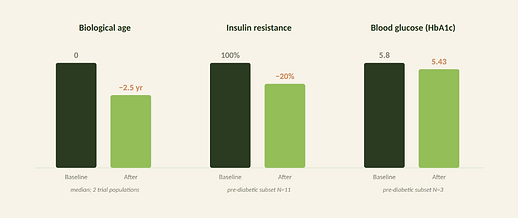
Food-based interventions produce measurable biological change. The strongest evidence comes from randomized controlled trials of the fasting-mimicking diet (FMD). In an analysis of trial data, cycles of the FMD were associated with an estimated reduction of about 2.5 years in a measure of biological age, alongside improvements in markers of insulin resistance and hepatic fat, with the biological-age effect reported as independent of weight loss.[Brandhorst 2024]
The mechanism Valter Longo and colleagues propose is a coordinated down-shift in the body's nutrient-sensing pathways — insulin, IGF-1, and mTOR — the conserved signals that set lifespan from yeast to humans. Levine's analysis turned this into an explicitly age-dependent rule: in people aged 65 and younger, lower protein intake tracked sharply reduced IGF-1 and mortality, yet the association reversed after 65, where adequate protein became protective. The honest reading is that the same lever points in opposite directions at different ages — a caution the cuisine carries rather than hides.[Fontana 2010][Levine 2014]
AN HONEST CAVEAT
Honesty requires stating the limits alongside the headline. The improvement in insulin resistance (HOMA-IR) was measured in a pre-diabetic subset of roughly eleven participants, and the change in HbA1c in a pre-diabetic subset of only three. A small subgroup can be suggestive; it cannot be load-bearing. Any figure reporting these outcomes must display the subgroup sample size as prominently as the effect.

CULINARY CONSEQUENCE
Deliberate structuring of what and when we eat can move the body's biology in a measurable, favorable direction — partly through pathways independent of simple caloric loss. This licenses a cuisine to treat metabolic signaling and timing as design variables, while forbidding it from promising any individual a specific clinical result.
3.3 · Foundation III — Compounds engage defined pathways through hormetic and xenohormetic mechanisms
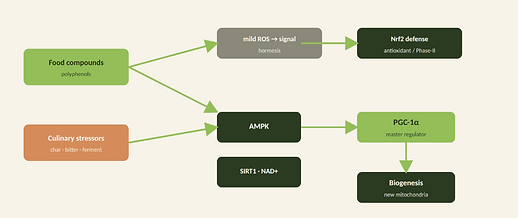
Two mechanisms matter most. The first is mitochondrial biogenesis — the making of new mitochondria — coordinated by PGC-1α and its upstream regulators, the energy sensor AMPK and the NAD⁺-dependent deacetylase SIRT1. The second is hormesis: a mild, transient stressor provokes an adaptive response larger than the stress itself, for example activating the Nrf2 pathway. A deeper evolutionary account is xenohormesis — plant defensive compounds acting, at the low doses humans consume, as mild stressors that activate our own adaptive signaling.[Chodari 2021][Perrone 2025][Vannuchi 2025][Lettieri-Barbato 2019][Divyajanani 2023]
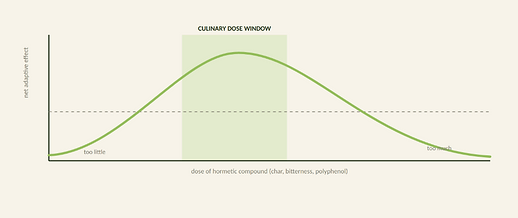
The signature of hormesis is a biphasic dose–response curve: too little stimulus yields no signal; too much becomes damage. This is why Mitochondrial Cuisine is emphatically not a doctrine of “more antioxidants” or “more char.” It is a doctrine of calibration — enough of a signal to provoke adaptation, never enough to injure.


CULINARY CONSEQUENCE
Ingredient selection and technique are levers on named biological pathways — but only within a calibrated dose window. The chef's art becomes, in part, the art of dosing a signal: enough to speak to the cell, never enough to shout.
3.4 · Foundation IV — Quality control: build and clear
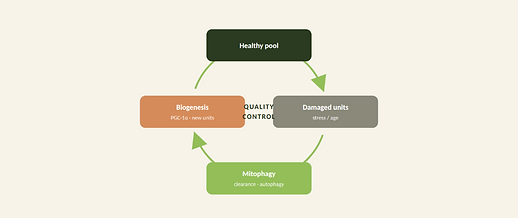
Cellular-energy health is not set by how many mitochondria a cell builds; it is set by the quality of the pool it maintains — which depends as much on clearing damaged mitochondria as on making new ones. This coupled process is mitochondrial quality control, with three motions: biogenesis, mitophagy (selective clearance of damaged mitochondria), and dynamics. Urolithin A, a gut-derived metabolite of dietary ellagitannins, activates mitophagy; the dietary polyamine spermidine induces autophagy.[Andreux 2019][Ryu 2016][Eisenberg 2016]

CULINARY CONSEQUENCE
A cuisine composes for two motions, not one: the biogenesis-leaning signals of char and bitterness, and the clearance-supporting compounds and intervals that keep the pool clean. The unit of design is not the single stimulus but the cycle of stress and recovery.
3.5 · Foundation V — Substrate is signal
A mitochondrion does not only read the polyphenols dissolved around it; it responds to the metabolic state that fuel choice creates, and that state is itself information. The clearest example is β-hydroxybutyrate (BHB). During fasting or carbohydrate restriction, the liver synthesizes BHB from fatty acids as fuel. But BHB is not only fuel. It is an endogenous inhibitor of class I histone deacetylases, reaching into the nucleus to alter which genes are read, and a ligand for cell-surface receptors. A fuel molecule doubles as an epigenetic and hormonal signal. That is the foundation in one sentence: substrate is signal.[Shimazu 2013][Newman 2017][Fang 2025][Wang 2021]
A corollary follows from treating fuel as information: the capacity to switch cleanly between glucose and fat oxidation — metabolic flexibility — is itself a readout of mitochondrial condition. San Millán and Brooks made the trait measurable through lactate and fuel-oxidation responses, and it has since become a centrepiece of popular longevity discourse. The cuisine borrows the concept as a design target — sequences that invite the body's own fuel-switching rather than lock it into a single substrate — while claiming nothing about any individual's metabolism.[San-Millán 2018]
CULINARY CONSEQUENCE
If the fuel is a signal, then a cuisine composes not only compounds but substrate context — the metabolic key the meal is played in. What it composes is a context, never an outcome.
The Metabolic-Theory Frontier and Its Limits
Foundation V walks the discipline up to the most oversold idea at the intersection of food and mitochondria, and it must be handled with unusual care. The claim — associated most prominently with the work of Thomas Seyfried and colleagues — is that cancer is fundamentally a mitochondrial metabolic disease, with somatic mutations as a downstream consequence rather than the cause. A discipline built on cellular energy cannot pretend this idea is not there. Neither can it endorse it. The honest response is to state it in three registers.[Seyfried 2015][Seyfried 2010][Seyfried 2025]
Register 1 — Established. The Warburg effect is real: most proliferating cells rely heavily on aerobic glycolysis even when oxygen is available. The mainstream interpretation, articulated by Vander Heiden, Cantley, and Thompson, is that this metabolic phenotype is largely a consequence of oncogenic signaling and the biosynthetic demands of proliferation — rather than a primary cause of malignancy.[Vander Heiden 2009]
Register 2 — Contested hypothesis. The stronger claim — that defective oxidative phosphorylation is the origin of most cancers — is a minority position that remains genuinely contested. It is peer-reviewed and argued in detail by its proponents, and it is rejected by most oncologists and cancer biologists. This document represents it as an active scientific debate about biology. It does not adjudicate it, and it does not build any culinary claim upon it.[Seyfried 2025]
Register 3 — Unproven for treatment. Whether metabolic or ketogenic strategies treat cancer in humans is a separate and largely unanswered clinical question. A systematic review and meta-analysis found that while ketogenic diets were safe for cancer patients and reduced body and fat mass, cancer-treatment-related indicators changed insignificantly. Nothing here should be read as endorsing dietary self-treatment of cancer.[Zhao 2022]
THE FIREWALL
Mitochondrial Cuisine is a cuisine for people who are well. It names this frontier because intellectual honesty requires acknowledging it, and it refuses to cross it because credibility requires refusing. No dish, ingredient, fuel state, or menu is offered as prevention or treatment for cancer or any other disease. Anyone with a medical condition is directed to a licensed clinician. This is not caution for its own sake; it is the load-bearing wall of the entire structure.
Theoretical Framework: Thesis, Commitments, and the Honest Line
From the five foundations follows a single organizing thesis:
Food is information the body's energy machinery reads. A cuisine can be composed — in its sourcing, its chemistry, its fire, and its timing — as a set of calibrated signals to that machinery. It never claims to treat, cure, or prevent disease.
Six commitments constrain every decision the cuisine makes. They are rules of composition, and the last two are rules of honesty without which the rest would be dangerous. The full set is set out on the Commitments page.
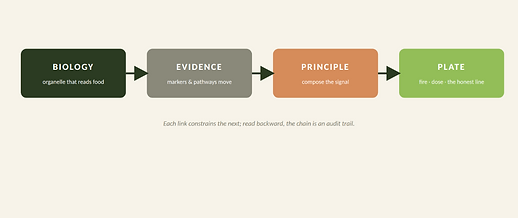
The framework is deliberately built so that no claim on the plate can outrun the evidence behind it. Biology constrains evidence; evidence constrains principle; principle constrains the plate. Read backward, the chain is an audit trail: for any choice in the kitchen, one can ask which principle it serves, which evidence supports that principle, and which biology underwrites that evidence — and if the chain breaks, the choice is decoration, not discipline.

Design Principles
The commitments become practice through a set of executable principles. They are written to be executed at the pass, not admired on the page. The complete set of thirteen principles — from Cook with living systems to Name the frontier at the pass — is presented in full on the Principles page.
Two principles carry most of the weight. Calibrated fire treats live fire as a dosing instrument: controlled heat generates aromatic compounds and mild hormetic stress, while excessive charring generates compounds better minimized. Technique is dose captures the same logic at the molecular scale: sulforaphane forms only when a crucifer is cut, and its forming enzyme is largely destroyed above roughly 60 °C. Cut, rest, heat, ferment, and hold are all doses.
From Theory to Plate: A Working Grammar
Theory earns its keep only if a kitchen can act on it. The bridge is a working reference, not a claim of clinical effect. Each entry states what a compound is, where a kitchen finds it, the pathway it engages, an honest grade of the evidence, and the culinary handle by which a chef controls it. No entry asserts that a dish treats, cures, or prevents disease. The full grammar is presented on the Grammar page.
A WORKED EXAMPLE, FRAMED HONESTLY
Consider a single composed course: a lightly charred brassica — cut and rested before cooking so its Nrf2-linked compound can form, then finished over gentle fire (P9) — set against a walnut-and-pomegranate element chosen because its ellagitannins are the dietary precursor to a mitophagy-linked metabolite (P8), with a spoon of an aged, fermented dairy contributing spermidine and acidity (P4, P7), and a bitter herb oil carrying botanical polyphenols (P3), composed within a lighter, lower-glycemic sequence (P11). Every element traces to a principle, and every principle traces to cited biology. What the course does not do is equally important: it does not claim to activate anyone's mitophagy, improve anyone's health, or prevent anything. It is a delicious plate composed on a coherent theory — and that, not a promised outcome, is precisely the claim the cuisine makes.
Reception and Public Discourse
A framework organized around cellular energy enters a crowded and often uncritical public conversation, and honesty requires describing that landscape rather than ignoring it. The ideas Mitochondrial Cuisine draws upon — fasting, ketosis, metabolic health, and the metabolic theory of cancer — circulate widely in podcasts, long-form video, and online forums, frequently detached from the evidence that supports them. High-reach media have amplified strong formulations of the metabolic-theory-of-cancer claim, at times including the assertion that mainstream oncology “has been wrong about cancer for 100 years.”
Science communicators have pushed back with equal force, characterizing the strongest ketogenic-cancer claims as “more hype than science.” Balanced fact-checks converge on a measured reading: the researchers involved are productive and have genuinely reframed aspects of cancer biology around metabolism, their preclinical and small clinical results justify further trials, but current evidence does not displace established, evidence-based therapies and remains contested.
This reception is not incidental to Mitochondrial Cuisine; it is the environment the discipline must survive in. The honest line and the firewall are the discipline's response: not a legal footnote, but the single feature that distinguishes a serious culinary theory from wellness marketing wearing a laboratory coat. Documenting the discourse, and refusing to participate in its excesses, is itself part of the method.
Position and Lineage
It matters to state precisely what is and is not novel here, because overclaiming novelty is its own form of dishonesty.
What is not new. Cooking with fresh, plant-forward, minimally processed ingredients is ancient. The health relevance of polyphenols, fermentation, and caloric timing is studied by many. And the intellectual posture of building a cuisine on biology has real precedents — most directly neurogastronomy, concerning how the brain constructs flavor and perception. Mitochondrial Cuisine acknowledges that lineage as a debt, not a rivalry: where neurogastronomy concerns how the brain constructs flavor, this discipline concerns how food communicates with the cell's energy machinery.
Distinction from culinary medicine. The discipline must be distinguished sharply from culinary medicine, a clinical and preventive field practiced by and for clinicians and patients. Mitochondrial Cuisine is explicitly not that. It is a culinary theory for people who are well, and its defining constraint is that it makes no disease claim of any kind.[Vasques 2024][Polak 2025]
What is genuinely new. The contribution is the organization itself: a single, named culinary discipline built rigorously around the mitochondrion as its organizing principle — uniting sourcing, technique, chemistry, and time under one theory; a compound-to-pathway grammar that lets a kitchen reason from cited biology to a specific decision at the pass; and an honesty discipline built into the foundation, in which the line between established science and culinary extrapolation is always drawn and never crossed.
9.4 · The wider field: the scientists and institutions behind the science
It bears repeating that the biology invoked throughout this work was discovered by others, and honesty requires naming them. Douglas Wallace founded human mitochondrial genetics; Vamsi Mootha's MitoCarta made the organelle's proteome systematically mappable; Bruce Spiegelman's laboratory discovered PGC-1α, the master regulator of mitochondrial biogenesis; and Navdeep Chandel established that mitochondrial reactive oxygen species act as deliberate signals rather than mere damage.[Wallace 2005][Pagliarini 2008][Puigserver 1998][Sena 2012]
The metabolic and clearance mechanisms this cuisine composes around were likewise mapped by named laboratories: Eric Verdin on β-hydroxybutyrate as a histone-deacetylase inhibitor, Johan Auwerx on urolithin-A-driven mitophagy, Frank Madeo on spermidine and autophagy, Valter Longo on the fasting-mimicking diet, and Satchidananda Panda on the metabolic power of eating within a bounded window. Carlos López-Otín and colleagues place mitochondrial dysfunction among the defining hallmarks of aging.[Shimazu 2013][Ryu 2016][Eisenberg 2016][Brandhorst 2024][Sutton 2018][López-Otín 2023]
A further layer of the field is translational in a different sense: physician-communicators who carry this metabolic science to a general audience. Valter Longo's work on the fasting-mimicking diet and nutrient-sensing pathways is primary research, cited as such; by contrast a figure like Peter Attia, whose longevity writing has popularised metabolic flexibility and the case against chronic hyperinsulinemia, is cited here as synthesis and communication — not as the author of the underlying experiments. Holding that distinction, researcher versus communicator, is part of the same honesty discipline that separates established science from culinary extrapolation.[Attia 2023]
A parallel translational effort runs through industry — Amazentis carrying urolithin A toward the clinic, L-Nutra formalizing the fasting-mimicking protocol as a food program, and companies such as Stealth BioTherapeutics, Elysium Health, and Pretzel Therapeutics pursuing mitochondrial and NAD⁺ biology as therapeutics. Mitochondrial Cuisine cites these researchers and institutions as the authors of the science it builds upon; none is affiliated with, or endorses, this culinary framework. The full roster is set out on the Scientists & Institutions page.
Testable Hypotheses and Research Agenda
A discipline that wants to be taken seriously must state what would prove it wrong. The hypotheses are framed to be testable with existing methods. Every one concerns food chemistry or short-term biological markers — not disease outcomes — and each is offered as an invitation to collaboration. The full agenda is presented on the Research page.
None of these, if confirmed, would license a health claim; each concerns a mechanism or a food-chemistry fact. The agenda is designed to make the cuisine falsifiable at the level where it actually operates, and to keep it there.
Limitations
Several limitations bound this work and are stated plainly. First, this is a theoretical and design framework authored by a chef, not a body of original empirical research; the biology is synthesized from others' work, and the culinary extrapolations are reasoned, not demonstrated. Second, much of the compound-level evidence is graded “emerging” — strong mechanistically or preclinically, but with causal human proof still thin — and the framework's honesty depends on that grade traveling with each claim rather than being quietly upgraded.
Third, the most quantitatively striking clinical figures invoked derive in part from small pre-diabetic subgroups and must not be over-read. Fourth, the contested material of the frontier is exactly that — contested — and is included as debate, not as a foundation for any claim. Fifth, individual variability means that composed signals cannot be assumed uniform across eaters. These limitations are not caveats appended to the work; they are constitutive of a discipline whose entire value proposition is honesty about what food can and cannot do.[Brandhorst 2024][Perrone 2025]
Conclusion
The science of the mitochondrion has changed enough to make cellular energy a defensible organizing principle for a cuisine. Mitochondrial Cuisine takes that shift seriously and asks a narrow, honest question: what does a cuisine look like if it treats the organelle that governs cellular energy as its organizing principle? The answer offered here is a thesis, five empirical foundations, six commitments, a set of executable principles, a compound-to-pathway grammar, a working method for the kitchen, and a falsifiable research agenda — held together by a refusal to claim more than the evidence allows.
What remains is the work: to test the hypotheses with laboratories willing to measure food and biomarkers honestly; to refine the principles against what the plate and the data actually show; and to build, in a real kitchen, the fullest expression of the theory.
The organelle has been listening all along. This is the beginning of cooking as though it were.
Disclosures
Author contributions. L.W. and R.W. conceived the framework and wrote the manuscript. Competing interests. The authors are the founders of Mitochondrial Cuisine and associated commercial and editorial ventures; this constitutes a potential conflict of interest and is disclosed accordingly. Funding. None. Medical disclaimer. This article presents a culinary theory and design framework. It is not medical, nutritional, or health advice. No dish, ingredient, technique, fuel state, or dietary pattern described treats, cures, or prevents any disease. Where the metabolic biology of disease is discussed, it is presented as an active scientific debate, never as guidance. Individuals with medical conditions should consult a licensed clinician.