§7
FROM THEORY TO PLATE
A Working Grammar
61
Entries
13
Compound families
25%
Established-grade
20+
Distinct pathways
FIG. A
Entries by compound family
FIG. B
Honest grade of the evidence
- Established
- Emerging
- Mixed
- Contested
- Category
TABLE 1
The families at a glance
Polyphenols
Polyphenols, Resveratrol, Quercetin, Epigallocatechin gallate…
Cofactors
Coenzyme Q10, NAD⁺ precursors, α-Lipoic acid, Vitamin K2…
Amino Acids
Glycine, Taurine, Leucine, Cysteine…
Sulfur Compounds
Sulforaphane, Glucosinolates, Allicin, Indole-3-carbinol…
Carotenoids
Lycopene, Lutein & Zeaxanthin, β-Carotene, Astaxanthin…
Fatty Acids
Omega-3 EPA / DHA, α-Linolenic acid, Oleic acid, MCT / C8…
Minerals
Magnesium, Selenium, Zinc, Iron
Microbial (SCFA)
Butyrate, Acetate & propionate, Live cultures, Postbiotic phenolic metabolites
Techniques
Char / Maillard, Fermentation, Cut-and-rest, Gentle heat
Alkaloids
Capsaicin, Piperine, Theobromine
Polyphenol-Derived
Urolithin A, Ellagitannins
Metabolic States
β-Hydroxybutyrate, Dietary nitrate
Polyamines
Spermidine
TABLE 2 — THE LEXICON
Every entry, graded honestly
A WORKED EXAMPLE, FRAMED HONESTLY
A single composed course: a lightly charred brassica — cut and rested before cooking so its Nrf2-linked compound can form, then finished over gentle fire (P9) — set against a walnut-and-pomegranate element chosen because its ellagitannins are the dietary precursor to a mitophagy-linked metabolite (P8), with a spoon of aged, fermented dairy contributing spermidine and acidity (P4, P7), and a bitter herb oil carrying botanical polyphenols (P3), composed within a lighter, lower-glycemic sequence (P11). Every element traces to a principle, and every principle traces to cited biology. What the course does not do is equally important: it does not claim to activate anyone's mitophagy, improve anyone's health, or prevent anything. It is a delicious plate composed on a coherent theory — and that, not a promised outcome, is precisely the claim the cuisine makes.

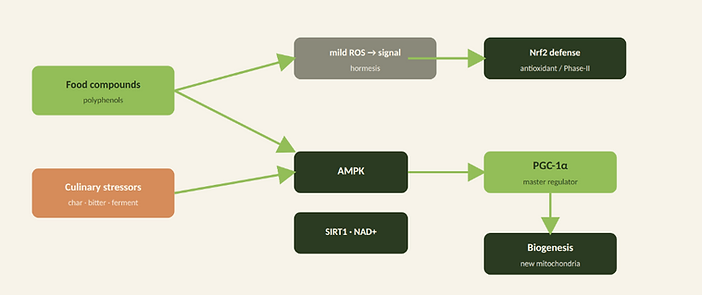
TABLE 3 — PLAIN TERMS
The shared vocabulary
The organelles, pathways, compounds, and measures the treatise depends on — defined in plain language.
- ATP
- Adenosine triphosphate, the cell's energy currency.
- Mitokine
- A signaling molecule (e.g., FGF21, GDF15) or peptide released under mitochondrial stress that coordinates responses across tissues.
- PGC-1α
- The master transcriptional coactivator of mitochondrial biogenesis.
- AMPK / SIRT1
- Energy- and NAD⁺-sensing regulators upstream of PGC-1α.
- Nrf2
- Transcription factor governing endogenous antioxidant and detoxification responses; activated hormetically.
- Hormesis
- A biphasic dose–response in which a mild stressor provokes beneficial adaptation while excess is harmful.
- Xenohormesis
- The cross-species transmission of stress resistance via plant-derived stress compounds.
- Mitophagy
- Selective clearance of damaged mitochondria; the “clear” motion of quality control.
- Autophagy
- The cell's self-cleaning and recycling program.
- Urolithin A
- A gut-derived metabolite of dietary ellagitannins that activates mitophagy.
- Spermidine
- A dietary polyamine that induces autophagy.
- Sulforaphane
- An Nrf2-activating compound formed when cruciferous vegetables are cut; heat-sensitive.
- β-Hydroxybutyrate (BHB)
- The principal ketone body; a fuel that also acts as an HDAC inhibitor and receptor ligand.
- Metabotype
- An individual's metabolic/microbial phenotype (e.g., urolithin “producer” vs. “non-producer”).
- HOMA-IR / HbA1c
- A blood index of insulin resistance / a marker of average blood glucose.
·No dish, ingredient, technique, fuel state, or dietary pattern described in this work treats, cures, or prevents any disease. The peer-reviewed science is cited to the researchers who produced it; the culinary theory, the design principles, and the honest line are the founder's.