§5 – §6
COMMITMENTS & DESIGN PRINCIPLES
From thesis to the pass
Food is information the body's energy machinery reads. A cuisine can be composed — in its sourcing, its chemistry, its fire, and its timing — as a set of calibrated signals to that machinery. It never claims to treat, cure, or prevent disease.
THE CONSTITUTION
The Six Commitments
Rules of composition — and the last two, rules of honesty without which the rest would be dangerous.
Food is information
Every ingredient, technique, and sequence is treated as a signal to cellular metabolism, not merely as fuel or flavor.
Dose is the discipline
Because the relevant biology is hormetic, the cuisine lives inside dose windows. It seeks enough of a stimulus to provoke adaptation and never enough to injure. “More” is not a strategy; calibration is.
Source determines signal
The molecular content of food is set long before it reaches the pass — by soil, variety, freshness, and how living the ingredient still is. A signal that was never in the ingredient cannot be plated.
The cycle is the unit
Cellular energy is maintained by two motions — building and clearing. The cuisine composes for both and treats the cycle of stress and recovery as the true unit of design.
The honest line
No dish treats, cures, or prevents disease, and the cuisine says so plainly wherever it speaks of science. Established findings are cited to their authors; original theory is labeled as such; the seam between the two is always visible.
Cite the debate, never sell the cure
Where the underlying science is genuinely contested, the cuisine represents the debate faithfully — including the mainstream counter-view — and builds nothing on the unresolved claim.
The audit trail
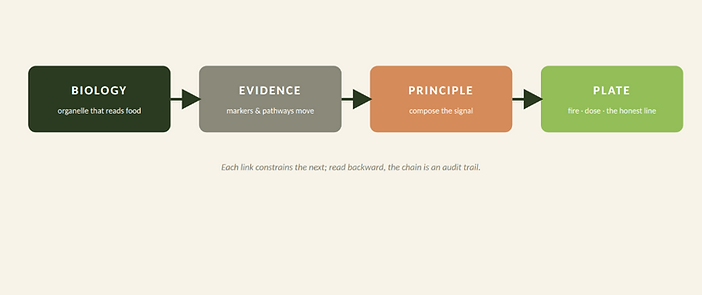
Biology constrains evidence; evidence constrains principle; principle constrains the plate. Read backward, the chain is an audit trail — if any link breaks, the choice is decoration, not discipline.

EXECUTABLE PRACTICE
The Thirteen Design Principles
Cook with living systems
The signal begins in the soil; freshly harvested, living produce carries a fuller complement of the bioactive compounds this cuisine cares about than produce degraded by time and distance.
Calibrated fire
Live fire is the central technique and the central hazard: controlled heat generates aromatic compounds and mild hormetic stress that can favor adaptive signaling, while excessive charring generates compounds better minimized. Fire is a dosing instrument.
Bitterness and botanical complexity
Many of the polyphenols and phytochemicals implicated in mitochondrial and Nrf2 signaling are bitter, astringent, or aromatic — the very flavors industrial food has bred out. Bitterness is treated as a feature.
Fermentation as a second kitchen
Fermentation generates organic acids and bioactive peptides and biosynthesizes compounds the raw ingredient did not carry, including the microbial conversion of polyphenols into their active metabolites and the elevation of spermidine in aged and fermented foods.
The meal as temporal structure
When food arrives is a design variable, not only what arrives; a tasting menu is already a temporal structure, and the cuisine composes that sequence with the cycle of stress and recovery in mind.
Sensory truth
Flavor is real information the nervous system constructs (the domain of neurogastronomy); the cuisine refuses the false choice between food that is good for the body and food that is good to eat.
Build and clear
Compose for both motions of the quality-control cycle: the biogenesis-leaning signals of char and bitterness, and the clearance-supporting compounds (ellagitannins, spermidine) and fasting-like intervals.
Cook for the gut that cooks for the cell
Some compounds become signals only after the microbiome transforms them; urolithin A is the clearest case, and a meaningful fraction of people are non-producers. The kitchen sources on three levels: the compound, its dietary precursor, and the microbial capacity to activate it.[Andreux 2019]
Technique is dose
How a compound is handled determines whether its signal survives to the plate; sulforaphane, absent from intact broccoli, forms only when the vegetable is cut, and its forming enzyme is largely destroyed above roughly 60 °C. Cut, rest, heat, ferment, and hold are all doses.
Match the compound to the eater
The same dish is not the same signal to every diner; microbiome metabotype, genetic variation, age, and metabolic state all change what a food communicates. The cuisine personalizes where it honestly can and never claims a universal effect.[Perrone 2025]
Compose for metabolic flexibility
Following Foundation V, the cuisine treats substrate context — the metabolic key of a meal — as a design variable, composing lighter, lower-glycemic sequences and honest fasting-like intervals without prescribing any diet to any diner.
Fuel is context
A dish's meaning depends on the metabolic state it lands in; the cuisine composes that context deliberately and states it plainly.
Name the frontier at the pass
Where a compound or state carries contested-therapy associations, the discipline names the boundary rather than exploiting the association.
·No dish, ingredient, technique, fuel state, or dietary pattern described in this work treats, cures, or prevents any disease. The peer-reviewed science is cited to the researchers who produced it; the culinary theory, the design principles, and the honest line are the founder's.